Sunday, 1 December 2013

Week #12 - The FINALE - What's My Citizenship?


Ribble,  Nine Elements of Digital Citizenship


Sadly, this will be my final blog for my participation in ADED1P32 - Learning in Digital Contexts Class - Fall 2013 at Brock University. 

Back in September, I thought this would be a great course to take to learn about web 2.0 tools to use for myself and for my students. Little did I know how right I was but little did I realize how much more I would actually experience. This was also my first online learning experience and I was not really looking forward to that. I had heard of so many disappointing experiences with online learning that I was not sure what to expect and frankly I was apprehensive about the whole thing.
When I started this course, I fancied myself someone who was quite tech suave. I think that was my first kick in the head - I was nowhere near what I thought I was - the realization came early in this course that I really had absolutely no concept of what is out there available to use (digitally speaking), and I had absolutely no idea of what it meant to be a Digital Citizen. 

("Internet world wide," 
Internet world wide web 
concept earth globe with
www text and computer 
hand cursor)
It frightens me now to think how ignorant I was of the responsibilities I have both as a learner and a teacher of being a good Digital Citizen.  Frankly, I, not unlike my students, felt it my right to use whatever I could find or access on the great WWW.
I am pleased to say this attitude has dramatically changed and I am now a proud Digital Citizen who is determined to go out and spread the good word.


Googled Myself - A positive Digital Footprint
Back in September, I googled myself!  I have to say I was quite shocked at what I found.  Information there was generated partically by my involvement with the web, but unfortunately, much of the information was inaccurate and most of it I did not want out on the web.  I learned quickly that there were things that I could not change, but I also learned there was a lot I could change - and so I set out to do so.
I edited all I could where there were links to information and images either not related to me or information I did not want out there.  Moving forward into the course, I was quite concerned about information that would now be available online through my blogs and tweets, but having reviewed and googled myself again today, I found the information accurate and for me confortable to have out in the digital world.  
Ioannides, J. c. 2013 Google Search
All information met the 'Netiquette' guidelines we had discussed throughout our term.  I am now aware of how important it is to communicate correct information online to ensure your Digital footprint is 'clean', it is vital for me to pass this knowledge on to my students, friends, and family.  We two young adults in my home (who LIVE online), I have asked them if they are aware of their digital footprint - and neither were.  We did some quick searches for them by name to see what was online attached to them, and I must say I am proud of what I saw.  


Quality Online Interactions with Others
LEADING BY EXAMPLE...I am dedicated to setting an example professionally and personally to sharing my new found knowledge and respect for the online education community.  In all my communications and through my learning 2.0 tools, I will ensure I personally exemplify the try meaning of a good...no and excellent Digital Citizen.  I will communicate with respect, I will keep my information and those of others safe and protected, I will be honest and responsible with my information online, I will obey the laws that govern our community, I will cite works used to the best of my ability and share my own works with the use of Creative Commons.  I will ensure my time online is responsible and not let it get out of control and I will definitely find a better chair to sit on when I work at my computer :).  This as a good Digital Citizen, I promise to do.  
I will share information with others to assist them with improving their own online interactions.  Many of the great links on my own ScoopIt collections (especially those curated since our week 6) will be key resources for me to share and educate with.


Helping Others Develop the Knowledge & Adopt Appropriate Behaviours
As educators, we face difficult decision regarding the use of digital tools and equipment in our classroom.  I have actually become very comfortable throughout this course in working with my students 'toys' rather than trying to fight them.  I have always set acceptable behaviour standards in my own classroom, but I would like to encourage our deans and chairs to create actual guidelines that we can all work with.  I think educating our higher ups on The Nine Elements of Digital Citizenship, can only bring a cohesive unified approach to educating our students and making them all responsible.  

For my focus, (Ribble, 2012) puts it quite simply for me, 
"Good digital citizens respect others and learn way to use technology courteously and effectively."
This is what I must bring to my school.
One of the first things I would like to work on next semester with my students, is and exercise in our textbook The Nine Elements of Digital Citizenship.
Digital Citizenship Pledge, Common Sense Media c. 2012
There are two lessons in the text that I find particularly excellent.  Guided Lesson 3 - Using the Internet Appropriately (Literacy) and Guided Lesson 8 - Digital Plagiarism (Rights and Responsibilities.  I have identified these areas needing urgent attention in my classrooms.  I will also share my results with my chair and dean when they are completed as this is not an uncommon issue among my fellow instructors.

I have found a few online communities that I am interested in continuing to follow after our class time is concluded.  They include:
  • CommonSenseMedia.org
  • Digitalcitizenship.net
  • K12learning20.wikispaces.com
  • Ted.com
  • Bill Gates Education Foundation
  • FreeTech4Teachers.com
  • Hand4class.com
  • 2learn.ca
  • coolcatteacher.com
  • Dave Burgess
  • eLearning Industry
  • Faculty Focus
There are a few more, but I think these are a great start to spring boarding me into a wonderfully productive 2014.  I will be implementing and sharing the tools I have explored and learned to explore over the last three months.

Happy Holidays and Happy New Year.

A special shout out to my new online friend and collaborative partner +Mary Lou Siviero.  Thank you for your support, creativity, guidance, and amazingly intelligent thoughts and blogs - I have enjoyed it tremendously and I do hope we will work together again really soon.


Wordle: DIGITAL CITIZENSHIP - THE 9 ELEMENTS
Ioannides, J. Wordle - Digital Citizenship c. 2013
References:


(2013, May 15). Internet world wide web concept earth globe with www text and computer hand cursor
            [Web Graphic]. Retrieved from http://www.ekdidactics.com/wp-content/themes/encon 
            /libs/timthumb.php?src=http://www.ekdidactics.com/wp-content/uploads/2013/05/14821565-
            internet- world-wide-web-concept-earth-globe-with-www-text-and-computer-hand-cursor-
            isolated-on-white.jpg&w=747&q=100 

Common Sense Media. (2012). Digital Citizenship Pledge [Web Graphic]. Retrieved from
           http://www.commonsensemedia.org/educators/pledge_poster

Ribble, M. (Artist). (2012, July 21). Nine Elements of Digital Citizenship [Web Graphic]. Retrieved from
           http://hlwiki.slais.ubc.ca/index.php/Digital_citizenship


Chasing a Double Rainbow - My YouTube Experiment


Here is my YouTube upload of me chasing a double rainbow!

Friday, 29 November 2013

Week #11 - Can You Hear Me Now?

This week was both gratifying and petrifying for me. By now you have met my first experiment of the week - my VOKI Avitar.  Now that was very cool to produce.   I loved creating my Avitar and was happy to be able to move her from VOKI to my blog!

I'd next like to address my exploration of MOOC's.  Massive Open Online Courses.  (Cormier, 2012) tells us that MOOC's are courses - they are not schools.  MOOC's are about connecting, collaborating, engagement and an event.  He goes on to use 7 key words/terms to describe MOOC's:
  1. Courses
  2. Engaging & Collaborative
  3. Open
  4. Free
  5. Inclusive Participation
  6. World Wide Distribution
  7. Life-Long Networked Learning opportunities
These words captured the essence of MOOC's for me. MOOC's are available to everyone who wants them, the work is shared by anyone willing to participate.  Participants can be contributors or not.  Participants keep the work and all they learned from it.  Information sharing in a structured yet graded environment.  How did I not know about this before?? I was pleased we were to review the Daphne Koller video again.  I find her inspiring and as the co-creator of Coursera, a woman to be admired for her brilliance.  After reviewing her talk for the second time, one key motivator she identified for herself to drive the concept for Coursera, was a saying by Thomas Friedman:
Friedman (Koller, 2012)
After my first viewing of her several months back, I took it upon myself to find out more about 'FREE LEARNING' from reputable Universities - was there a benefit to me and potentially my degree.  There were many courses offered at Brock that I would have to take but I wasn't really interested in - could this environment offer me an interesting yet credit worthy opportunity?  I have found several courses, and I will inquire with Brock if I can actually use them as credits!  I even got my husband enrolled in an economics course at Stanford through Coursera - LOVE IT! As with anything wonderful, there are always critics.  John Gold and David Coffey took it upon themselves to critique another MOOC environment - the Khan Academy. (Chen, 2012) notes in her blog that the professors 'biggest gripe is with the procedural, rules-based approach in all of Mr. Khan’s videos.  Khan Academy videos can be effective supplements to classroom teaching, says Mr. Golden, whose specialty is math education. But he argues that they do not encourage students to think critically. “If I have a bone to pick with the videos that I’ve seen so far, it’s that they tend to be about giving students rules and asking them to practice rules, as opposed to problem-solving,” he says. So who says everyone has to think just one way?  

This lead me to my next exploration this week - listening to the great Bill Gates discussing his book, The Road Ahead, where is discussed his vision of education how it could be transformed with technology with Jeffrey Young (Young, 2012).  He also spoke to society's need for 'degrees'.  
(Gates, 2012), "if you have a great degree then you're considered for jobs, and if you don't have that degree there are a lot of jobs you won't be considered for.  He continues, "the question is, Can we transform this credentialing process? And in fact the ideal would be to separate out the idea of proving your knowledge from the way you acquired that knowledge."
This quote I will carry with me always...and explore what I can do to move this concept into reality.

After all of this, I was further motivated to learn more about MOOC's.  I found many of the videos we were assigned outdated so I found a brand new one.  The embeded video proved most beneficial to me in further understanding the benefits of MOOC's to our world learning and Digital Citizenship growth and understanding.
 
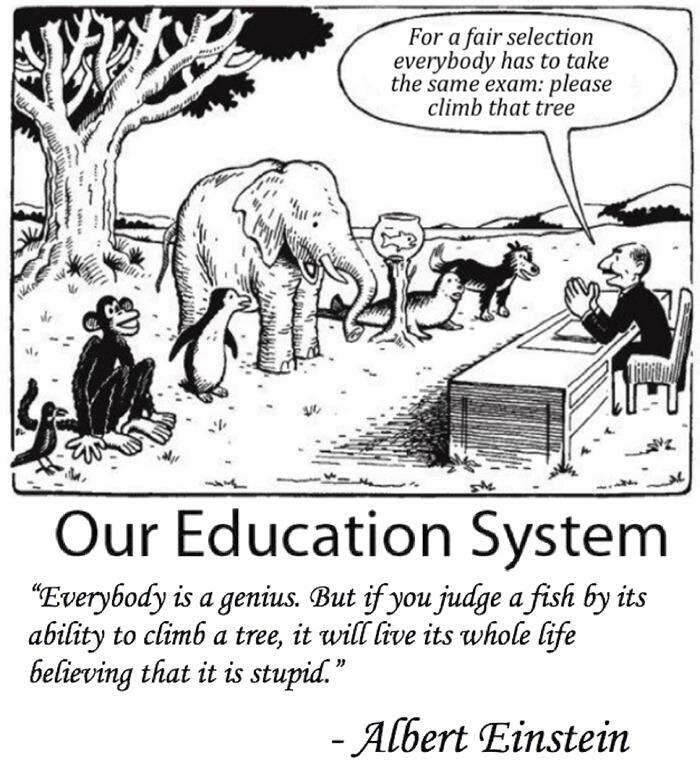
(Cooper, Our Education System)
Demystifying MOOCs! from Zaid Alsagoff  
This week continued with some fun from my Feedly.  This comic fit so well into my exploration of education equality and MOOC's, that I had to share it with you here.  I believe it speaks to Bill Gates vision and just reemphasizes that education is an individual journey and one size does NOT fit all!


I explored a few more things this week.  They included:
Webcasting, Podcasting, Screencasting, TeacherTube, SchoolTube, and or course YouTube.  I then went into creation mode and created a screen cast (on how to add pages to your blog) as well as uploading a video (Chasing a Double Rainbow) - I hope you enjoy both.  

Once I got the hang of it it was fine - BUT...it was very time consuming (as is any new task.  Will I use it again - Oh YES!  My students could use this for presentations, and assignment submissions.  My wheels are turning for January 2014.
My final task this week was to insert Creative Commons into my own blog.  Ensuring my work is used with my approval and with acknowledgment of contribution is very important to me and as these months have passed I have come to understand how this respect of the digital world contributors must be extended to all and must be taught to all.  The process of acquiring my own CC was very easy and embedding it into my blog just as easy.   You will find my Creative Commons on the footnote of my blog home page.

Enjoy my rainbow chase (PS I haven't caught it yet)!
     

References:

Chen, A. (2012, June 28). Parody critiques popular khan academy videos. Retrieved from http://chronicle.com/blogs/wiredcampus/parody-critiques-popular-khan-academy-videos/37543 

 Cooper, S. (Artist). (2013, November 26). Our Education System [Web Drawing]. Retrieved from
                 https://pbs.twimg.com/media/BZ_qJp4IEAEDYip.jpg:large 

                Cormier, D. (Writer) (2012). What is a mooc? [Web]. Retrieved from http://youtu.be/eW3gMGqcZQc

                Koller, D. (Performer) (2012, August). What's new about mooc's. TED Talk. [Video podcast]. Retrieved
                                from http://on.ted.com/Koller

Young, J. (Performer) (2012). A conversation with bill gates about the future of higher education [Web]. Retrieved from http://chronicle.com/article/A-Conversation-With-Bill-Gates/132591/


Sunday, 24 November 2013

Week #10 - RemixedUp! (has anyone copyrighted that??)

Week 10 - Time sure does fly when you are having fun.

I took a lot of time going through the weekly exercises including the Background Readings.  Topics of this week - Remix and Creative Commons.  I found though that I really got tied up in the Creative Commons this week and missed much of the fun of Remix.  I really wish I had spent more time on the creative tools!

Having said this, the week started with the great video - Kirk Ferguson: Embrace the Remix. One of my favourite quotes in the video truly defined the term 'remix' for me. 
(Ferguson, 2012) quotes Henry Ford: 

"I invented nothing new, I simply assembled the discoveries of other men behind whom were centuries of work. Progress happens when all the factors that make for it are ready and then it is inevitable."
This lead me to thinking of my own understanding of how we take ideas and continued to build on them.  We take a thought or idea from one area, mix it with an experience of another world and tweak it with a recent conversation and VOILA! and idea is created. (Ferguson, 2012) continued by stating what resonated more than any other statements this week when he said:
" Our creativity comes from without, not from within.  We are not self-made.  We are dependent on one another, and admitting this to ourselves isn't an embrace of mediocrity and derivativeness.  It's a liberation from our misconceptions, and it's an incentive to not expect so much from ourselves and to simply begin."  
But why should we not expect so much from ourselves?  I think we should push ourselves to reach to the stars to create and invent!  Search out the ideas, search out for inspiration, search out for motivation and then make it yours!

I do however understand now the connection in this week between Remix and Creative Commons.  Having never been "educated on Copyrights (even though it's posted everywhere at school), I could not be bothered to read the why's what for's and what if's about the concept that I can't copy notes or pictures or use images in my presentations for my students.  After reading Fair Dealing For Media Education article this week, it started to actually make sense to me why restrictions (guidelines) are in place.  There is a lot of legal jargon involved and I struggled to understand it...until it lead me to Creative Commons Licenses and how these would be a great alternative to explore for in class work.

I printed for my own reference use (and potentially sharing it with my fellow teachers), the
Resources and Tools from 2Learn.ca to support Digital Life Skills - the explanation of the Canadian Copyright 9 Key Questions and the 19 Copyright Resources will prove most useful.

Although juvenile and YouTube directed, the Teaching Students About Copyright -The YouTube Way video was quite on the money.  Simple but to the point - I will share this with my students and encourage a class discussion (they are presenting their term projects shortly).

This lead me to the Creative Commons: What Every Educator Needs to Know video.  Although quite long, it really made me understand the benefit of using Creative Commons both as a creator and a user of material that may be used by others.  I exercised my own Creative Commons rights by loading some of my personal pictures to Flickr and setting Creative Commons restrictions on them.  This did give me a sense of empowerment - both to share but most importantly to get credit for my sharing.  (I have been struggling with this on my PLE).  I found the types of licenses were so very well explained in the video that applying these to my images worked well - I understood it!

I am attaching my link to My Prezi Creative Commons presentation blog.  If was a great (but VERY time consuming exercise).  I can visualize myself using this for presentations in class but also asking students to use this tool to create presentations.  Need to try something new (PowerPoint burn out happening!). 

My final task this week was to try out Animoto.  I have seen it so often and heard about it, and yet no knowledge at all about this tool.  I wanted to do something a little special dedicated to my youngest brother who I lost tragically 3 years ago.  I miss him terribly and this is a little something just for him - Dedicated to Oliver Bodemann!

The Story of Three

Well - on that note...I love these new creative tools - now personally as well as professionally.  I have a few more to explore including Screencast which Kristy-Anne included in her blog.  It was great - How to create your first Animoto.
Thanks for the help on that one Kristy-Anne.

J

References:
Ferguson, K. (Performer) (2012). Embrace the remix [Web]. Retrieved from http://www.ted.com/talks/kirby_ferguson_embrace_the_remix.html